
Book Appointment Now

Genoxus Variant Analysis™ — v1.0
A Comprehensive Genomic Analysis for Unsolved Cases
Look Deeper. Discover More.
Genetic sequencing can uncover thousands of variants, but identifying the clues that matter most requires more than a list of results. Even when a genetic test does not provide a clear answer, the data may contain findings worth exploring deeper.
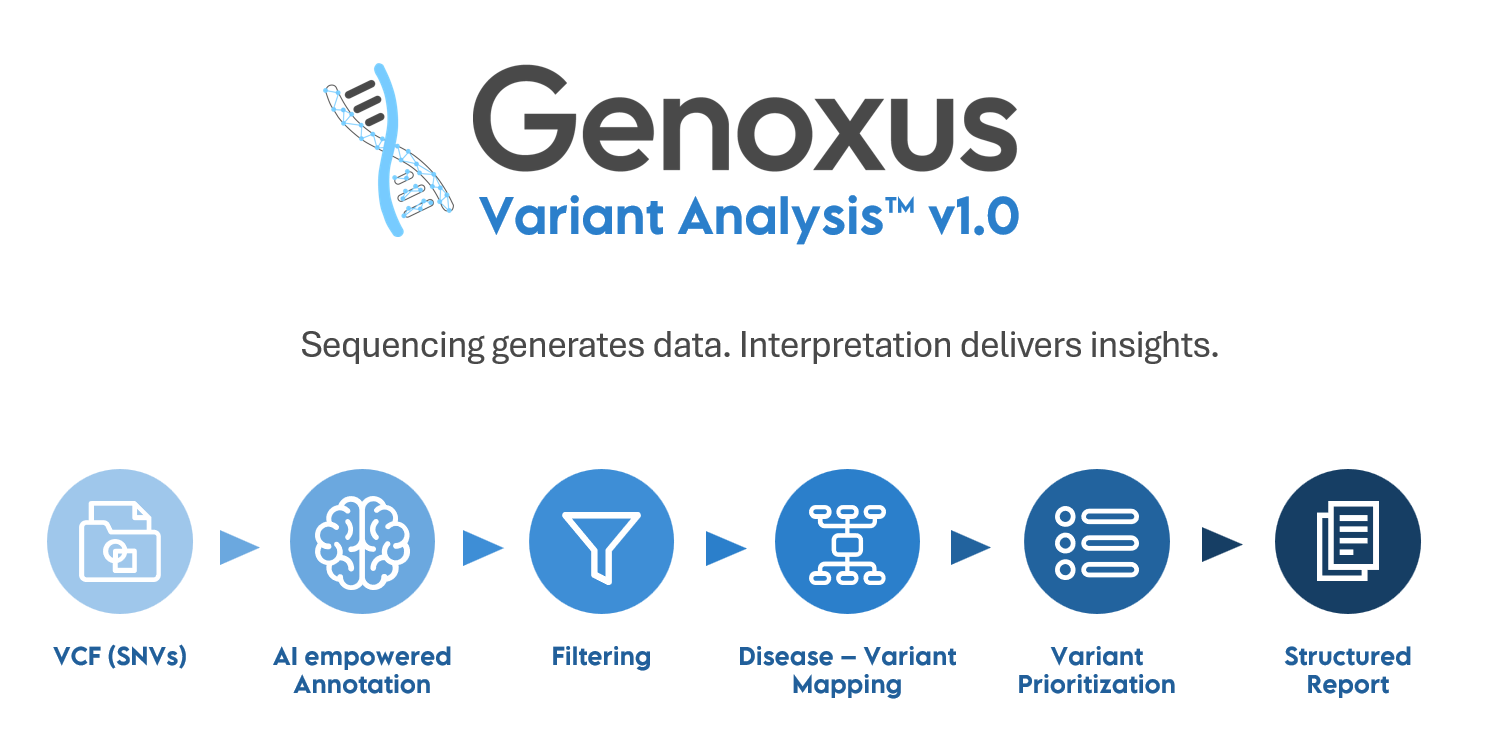
Genoxus Variant Analysis™ helps research teams re-analyze Whole Exome Sequencing (WES) VCF data, connect genetic variants with disease-related evidence, and organize findings into a structured research report. By bringing variant information and available evidence together, Genoxus helps researchers identify promising leads, develop research hypotheses, and determine which findings may warrant further investigation in complex or unresolved cases.
Research-use offering. Not a diagnostic service.
Genoxus Variant Analysis™ v1.0
A research-focused approach to genomic variant analysis
Designed for research teams working with WES data, Genoxus Variant Analysis helps organize genetic findings and supporting evidence for further review.
Key capabilities include:
- Variant-to-Disease Mapping: Connect genetic variants with reported disease associations.
- Variant Identification & Review: Highlight variants associated with a medical condition, identify those reported as pathogenic in available annotation evidence, and organize variants of uncertain significance (VUS) whose clinical or biological relevance remains unclear.
- Primary variant: the variant directly related to the patient’s medical complication
- Pathogenic variant: the variant has been classified as pathogenic or likely pathogenic
- VUS: the variant of unknown significance
- Structured Research Reporting: Bring findings together in a PDF report for review by the research team.
[Coming Soon] Version 1.1 – will support rsid-containing CSV file processing (e.g., 23andMe)
The report is intended to support research and further investigation. Findings require appropriate review and confirmation, and a research report should not be treated as a clinical diagnosis.
The report is intended to support research and further investigation. Findings require appropriate review and confirmation, and a research report should not be treated as a clinical diagnosis.
Who Is This Service For?
- Researchers investigating genetic disorders.
- Genetic Counselors guiding patients navigating difficult diseases.
- Biopharma R&D Teams characterizing patient genotypes for target discovery or stratified medicine programs.
- Advanced Patient Advocates & Families (working with their care team) who have WGS data and seek a comprehensive analysis to inform further clinical consultation.
- Research Scientists and Academic Labs – Explore genetic findings in complex or unresolved research cases.
- Sequencing and Genomics Laboratories – Add a research-focused analysis and reporting option for supported WES VCF data.
- Rare-Disease Foundations and Research Collaborators – Support investigations into unresolved genetic questions and potential research leads.
- Bioinformatics and Genomics Teams – Organize variant findings and supporting evidence for further review.
- For Families and Individuals: We will soon release our Genoxus DNA Insights™. Genoxus DNA Insights makes personal genetic data easier to understand. By re-analyzing supported consumer DNA raw files (e.g. 23andMe.com), Genoxus helps general users explore genetic variants, discover relevant scientific insights, and better understand what their DNA may reveal.
If your team has WES VCF data and wants to investigate the findings further, Genoxus can help you explore whether Variant Analysis is suitable for your research needs. Contact us to discuss your project, confirm file compatibility, and learn about the submission process and pricing.
Disclaimer: Genoxus materials, reports, analyses, and platform outputs are provided for research, educational, and informational purposes only. They are not intended to serve as clinical, diagnostic, or medical advice and have not been validated or approved for use in medical decision-making. Any insights or interpretations generated by Genoxus are exploratory in nature and are intended to support research, evaluation, and collaborative learning. These materials should not be used as the sole basis for diagnosis, treatment, patient management, or healthcare decisions. All medical or clinical decisions should be made in consultation with qualified healthcare professionals and supported by appropriately validated clinical testing.
Join Us on the Journey
We collaborate with clinicians, researchers, healthcare organizations, and strategic partners who share our commitment to advancing precision medicine.