

Genoxus Variant Analysis™ [WES]
$125.00
Genoxus Variant Analysis™ (GVA) is a research-focused genomic interpretation service that re-analyzes Whole Exome Sequencing (WES) VCF data to identify and prioritize potentially relevant genetic variants. Combining variant annotation, disease-association evidence, phenotype correlation, and AI-assisted prioritization, GVA organizes findings into a structured PDF research report to help investigators explore complex and unresolved genetic cases.
Research Use Only (RUO). Not intended for clinical diagnosis or medical decision-making.
Genoxus Variant Analysis™ — WES Support
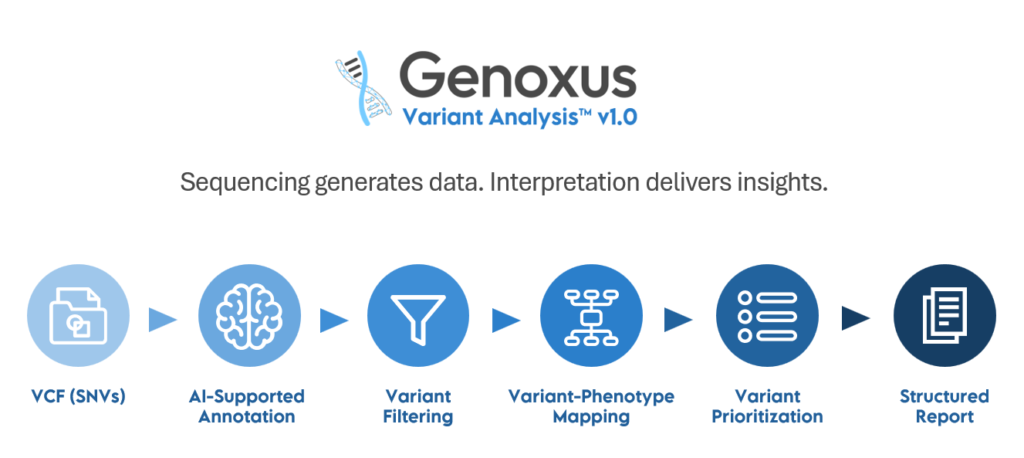
Genoxus Variant Analysis™ (GVA) is a research-focused genomic interpretation service that analyzes (and re-analyzes) Whole Exome Sequencing (WES) VCF data (or CSV, TXT, other formats) to identify and prioritize potentially relevant genetic variants. Combining variant annotation, disease-association evidence, phenotype correlation, and AI-assisted prioritization, GVA organizes findings into a structured PDF research report to help investigators explore complex and unresolved genetic cases.
Research Use Only (RUO). Not intended for clinical diagnosis or medical decision-making.
- Variant-to-Disease Mapping: Connect genetic variants with reported disease associations.
- Variant Identification & Review: Highlight variants associated with a medical condition, identify those reported as pathogenic in available annotation evidence, and organize variants of uncertain significance (VUS) whose clinical or biological relevance remains unclear.
- Primary variant: A candidate variant prioritized for its potential relevance to the condition or phenotype under investigation.
- Pathogenic variant: A variant classified as pathogenic or likely pathogenic in available annotation evidence.
- Variant of Uncertain Significance (VUS): A variant for which current evidence is insufficient to determine its disease-related significance.
- Structured Research Reporting: Bring findings together in a PDF report for review by the research team.
[Coming Soon] Version 1.1 – will support rsid-containing CSV file processing (e.g., 23andMe)
[Current] Version 1.0 – all features and functions are noted above.
The report is intended to support research and further investigation. Findings require appropriate review and confirmation, and a research report should not be treated as a clinical diagnosis.
Disclaimer: Genoxus and our collaboration partners’ materials, reports, analyses, and platform outputs are provided for research, educational, and informational purposes only. They are not intended to serve as clinical, diagnostic, or medical advice and have not been validated or approved for use in medical decision-making. Any insights or interpretations generated by Genoxus are exploratory in nature and are intended to support research, evaluation, and collaborative learning. These materials should not be used as the sole basis for diagnosis, treatment, patient management, or healthcare decisions. All medical or clinical decisions should be made in consultation with qualified healthcare professionals and supported by appropriately validated clinical testing.